
Quick Summary
Can lemon balm help with anxiety? Early research suggests it may ease mild, short-term stress, with effects measured within one to three hours of a single dose. It has not been shown to treat clinical anxiety disorders, so it is best viewed as a supportive option rather than a replacement for treatment.
- A 2014 study found reduced state anxiety after a drink containing 0.3 g of lemon balm.
- A 2021 meta-analysis found lemon balm may improve anxiety and depressive symptoms, especially in acute settings.
- Long-term safety and effectiveness data for lemon balm remain limited.
- Standardized supplements are easier to compare with research than home-brewed tea.
- See a doctor if anxiety affects your work, sleep, or daily life for several weeks.
Table of Contents
- What Research Says About Lemon Balm and Anxiety
- How Lemon Balm May Affect Mood, Stress, and Sleep
- How Long Does Lemon Balm Take to Work for Anxiety?
- Lemon Balm Dosage for Anxiety: What Studies Used
- Lemon Balm Tea for Anxiety vs. Extracts and Supplements
- Lemon Balm Side Effects, Interactions, and Who Should Avoid It
- When to Talk With a Doctor About Anxiety Before Trying Lemon Balm
- Frequently Asked Questions
What Research Says About Lemon Balm and Anxiety
Last Updated: November 1, 2026
Can lemon balm help with anxiety? Early research says it may, at least for short-term, mild stress. A 2014 study found a significant drop in state anxiety after people drank a beverage containing 0.3 g of lemon balm, measured at both 1 and 3 hours after drinking (Anti-Stress Effects of Lemon Balm-Containing Foods, 2014 study). That is a useful signal, but it is not proof that lemon balm treats an anxiety disorder.
Here is what the current research shows, and where it stops.
What the Human Studies Actually Measured
Most human studies on lemon balm measure short-term effects. They look at how calm or anxious someone feels after a single dose, or over a few weeks.
A 2021 systematic review and meta-analysis indexed by PubMed concluded that lemon balm may improve anxiety and depressive symptoms, especially in acute settings (systematic review and meta-analysis on lemon balm, depression and anxiety, 2021). The word "may" matters. The review describes a promising signal, not a settled result.
A 2024 review also summarized a study that gave 1,200 mg of lemon balm daily across three menstrual cycles. That study reported lower anxiety, depression, and insomnia scores compared with symptoms of premenstrual syndrome (2024 review of lemon balm clinical efficacy, PMC). That population and setting are narrow, so the result does not transfer to everyone.
Why Study Quality Matters for Interpreting Results
Not all studies are built the same way. Sample size, control groups, and how researchers measured anxiety all change how much weight a result deserves.
Many lemon balm studies are small or short. Some use a specific extract or a specific drink, not a tea. A result from one product format does not automatically apply to another.
- Short-term measures: Show how someone feels in the hours after a dose.
- Long-term data: Still limited for most lemon balm products.
- Clinical anxiety: Little direct evidence exists for diagnosed anxiety disorders.
How Lemon Balm May Affect Mood, Stress, and Sleep
Lemon balm belongs to the mint family. Explore the L-theanine guide to sleep quality for a look at another calming compound. Traditional use links it to calm, and the research so far points in a similar direction for mild, situational stress.
Some clinicians describe lemon balm tea as possibly moderately calming. They also note it probably will not be effective for clinical anxiety (Psychiatry Advisor, sleep disorders and anxiety calmed with lemon balm). That view matches the evidence: a gentle, relaxing ritual, not a replacement for treatment.
The same review that looked at anxiety also described possible cognitive and sleep-quality benefits. Those findings are early, so treat them as hopeful, not conclusive.
How Long Does Lemon Balm Take to Work for Anxiety?
Short-term studies have measured effects within about one to three hours of a single dose. That is the window where most of the positive data appears.
Effects from longer use are less clear. Studies that tracked symptoms over several weeks or cycles report changes, but they involve specific doses and populations. If you do not notice anything after a reasonable trial, that is useful information too.
Lemon Balm Dosage for Anxiety: What Studies Used
Study doses of lemon balm vary so widely that there is no single "right" amount for anxiety. The two most-cited human studies illustrate the range:
- Beverage study (2014): 0.3 g of lemon balm in a drink, measured at 1 and 3 hours after consumption (Anti-Stress Effects of Lemon Balm-Containing Foods, 2014 study).
- Menstrual-cycle study (summarized in a 2024 review): 1,200 mg of lemon balm daily across three menstrual cycles (2024 review of lemon balm clinical efficacy, PMC).
Those numbers are not interchangeable. The 0.3 g figure refers to lemon balm in a food-like beverage, while the 1,200 mg figure refers to a daily supplement dose taken over months. A tea brewed at home falls somewhere in between and is difficult to standardize because leaf quality, water temperature, and steep time all change the amount of active compounds in the cup.
How to Think About Dosing Without a Standard
Because no official dosing standard exists for lemon balm and anxiety, most practitioners take a stepwise approach:
- Start low. Begin with a single cup of tea or the lowest labeled supplement dose, and note how you feel over the next few hours.
- Pick one form and stay with it. Switching between tea, tincture, and capsules makes it hard to tell what is working.
- Give it a fair trial. Short-term studies measured effects within 1 to 3 hours of a single dose, but longer studies ran for weeks or menstrual cycles. A reasonable personal trial is several weeks of consistent use, not a single cup.
- Stop if it does not help. If you notice no change after a few weeks, that is useful information. More is not necessarily better, and higher doses have not been shown to be more effective for anxiety.
What the Labels Do Not Tell You
Supplement labels in the United States are not held to the same premarket review standards as prescription drugs, so the actual amount of lemon balm in a capsule or tincture can differ from what the label states. Look for products that list the plant part used (leaf is most common), the extraction ratio or standardization marker, and a batch or lot number. Those details are a better signal of quality than a large milligram number on the front of the bottle.
If you are working with a healthcare professional on an anxiety plan, bring the product label to the appointment. That conversation is more useful than any single dose figure from a study.
The two most-cited human studies used very different doses, as summarised below.
| Study | Lemon balm dose | Timing or duration |
|---|---|---|
| Beverage study (2014) | 0.3 g in a drink | Measured at 1 and 3 hours |
| Menstrual-cycle study (2024 review) | 1,200 mg daily | Across three menstrual cycles |
Lemon Balm Tea for Anxiety vs. Extracts and Supplements
Most lemon balm studies use a specific prepared form, not a generic "lemon balm." That matters because tea, liquid extracts, and standardized capsules deliver different amounts of active compounds, and a result from one form does not automatically apply to another. Here is a form-by-form comparison to help you choose responsibly.
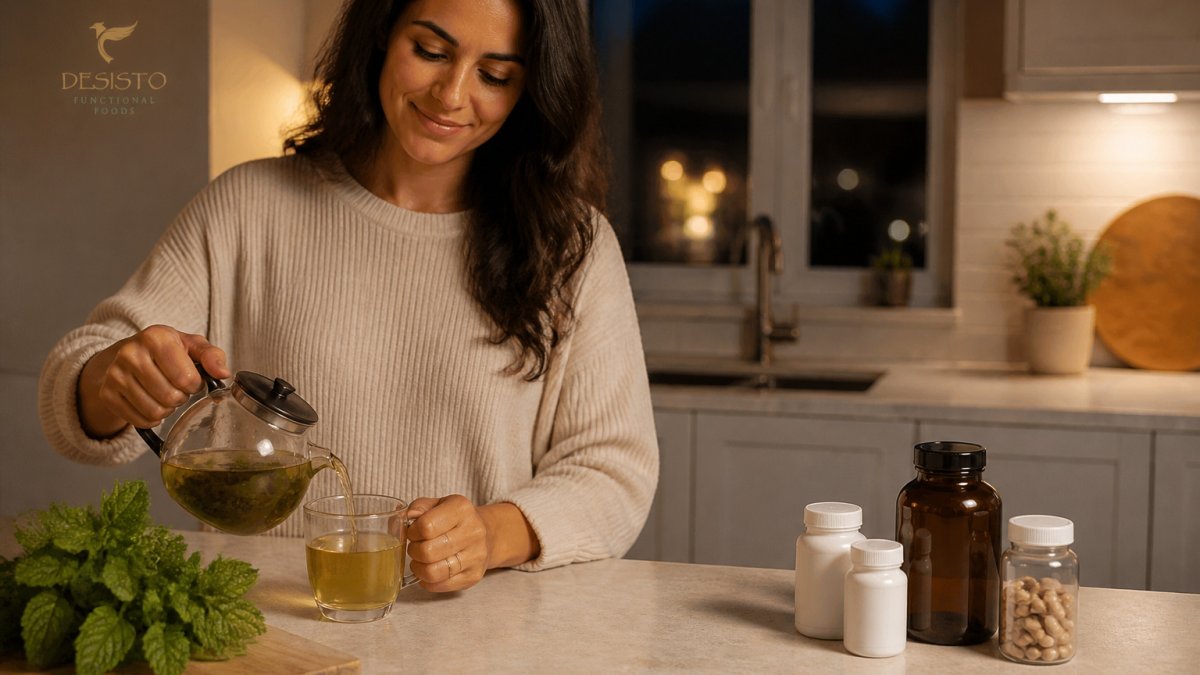
Tea
- Evidence: Tea is the form most people associate with calming, but it is the least studied in controlled trials. Most human studies used beverages or extracts, not home-brewed tea.
- Concentration: Variable. Leaf quality, water temperature, and steep time all change the strength of the cup.
- Practical use: Easy to adjust, easy to stop, and well suited to an evening ritual. Not ideal if you need a consistent, measurable dose.
Liquid Extracts and Tinctures
Liquid extracts are more concentrated than tea and are usually taken in small measured amounts, often by dropper.
- Evidence: Some studies used liquid or beverage preparations, but formulations differ enough that results are hard to compare directly.
- Concentration: Higher than tea, but alcohol- and glycerin-based products vary widely in strength.
- Practical use: Convenient and fast-acting, but the taste is strong and dosing depends on the product.
Standardized Supplements
Standardized capsules and tablets are labeled to contain a set amount of lemon balm or a marker compound, which makes them the easiest form to compare with published research.
- Evidence: The 1,200 mg daily dose summarized in the 2024 review is the kind of figure that standardized products can match (2024 review of lemon balm clinical efficacy, PMC).
- Concentration: Labeled and consistent from batch to batch, at least in theory.
- Practical use: Best for people who want a repeatable dose, but quality still varies by brand, and labels are not premarket-verified in the United States.
How to Choose
Our SleepDeep Dark Chocolate Squares combine clinically studied ingredients, including lemon balm, chamomile, melatonin, and L-theanine, in a single-serve format. Pricing depends on quantity and delivery, so check our website for current pricing.
What None of These Forms Can Do
No tea, extract, or supplement has been shown to treat a diagnosed anxiety disorder. If anxiety is persistent or interfering with daily life, a product choice is not the answer. Talk with a healthcare professional about evidence-based care, and treat lemon balm as a supportive option for mild, situational stress rather than a replacement for treatment.
Lemon Balm Side Effects, Interactions, and Who Should Avoid It
If you take prescription medication, do not start lemon balm without checking with a healthcare professional. Learn how melatonin itself can cause grogginess and what to do about it.
When to Talk With a Doctor About Anxiety Before Trying Lemon Balm
See a doctor if anxiety affects your work, sleep, relationships, or daily life for several weeks. Read how to choose natural alternatives to prescription sleep medication to discuss with your clinician. Persistent worry, panic attacks, or constant racing thoughts can signal a condition that needs professional care. See seven steps to stop racing thoughts at night.
Lemon balm is best viewed as a mild, supportive option for everyday stress. It is not a substitute for therapy, diagnosis, or prescribed treatment.
Frequently asked questions
Can lemon balm help with anxiety? Some studies suggest it may ease mild, short-term anxiety. It has not been shown to treat clinical anxiety disorders.
How long does lemon balm take to work? Short-term studies measured effects within one to three hours of a single dose. Longer-term effects are less well documented.
Is lemon balm safe to take every day? Long-term safety data is limited. Speak with a doctor, especially if you take other medications.
Frequently Asked Questions
How long does lemon balm take to work for anxiety?
The most specific data comes from a 2014 study of a lemon-balm-containing drink, which reported significantly reduced state anxiety at both 1 and 3 hours after consumption. That means some people in that study noticed effects within an hour. Results vary by person, dose and form, and the research measured short-term feelings of calm rather than treatment of an anxiety disorder. If you do not notice a difference after a reasonable trial, that is worth discussing with a healthcare professional rather than increasing the amount on your own.
What dosage of lemon balm has been studied for anxiety?
Study doses vary widely. A 2014 study used a drink containing 0.3 grams of lemon balm, while a 2024 review summarized a study using 1,200 milligrams daily over three consecutive menstrual cycles, which reported lower anxiety, depression and insomnia scores in that population. Because products differ in concentration, a study dose does not translate directly to a tea bag or a supplement. Check the label and ask a healthcare professional before choosing an amount.
What are the side effects of lemon balm?
People who are pregnant or breastfeeding, have a medical condition, or take prescription medication should check with a doctor before use.
Can you take lemon balm with melatonin or other supplements?
Anyone already taking sleep aids, antidepressants or anxiety medication should speak with a pharmacist or doctor before combining products. Keeping track of what you take and when makes those conversations more useful.
